
I Ching
How to Use I Ching Coins: The Three-Coin Method
Three coins, six throws, and four possible totals. Keep the scoring convention and the bottom-to-top order consistent.
On this page
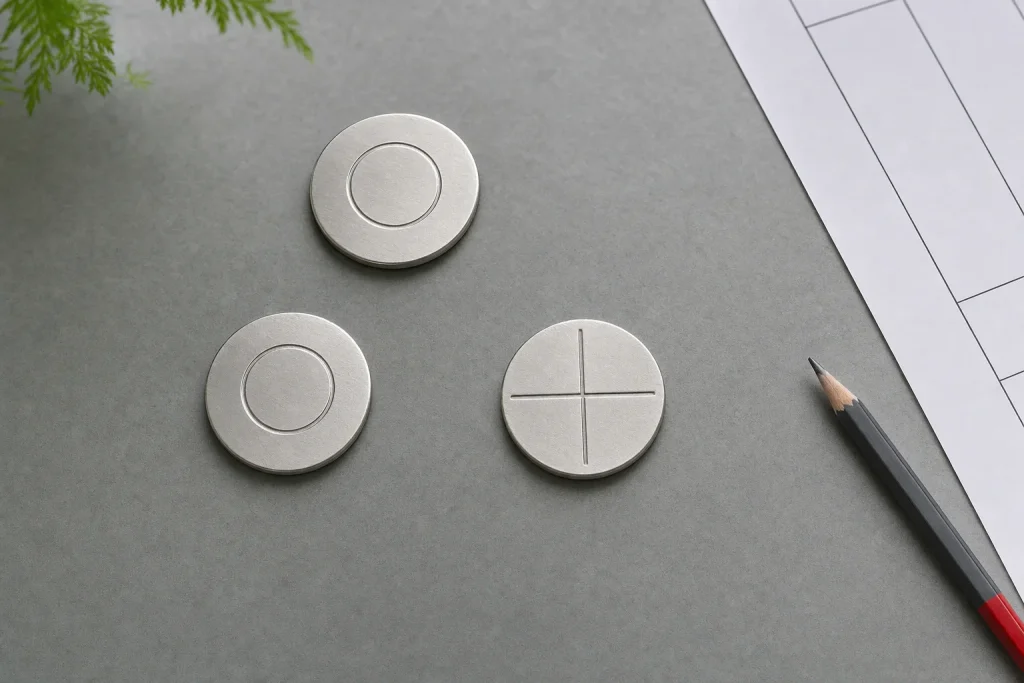
The method in one paragraph
To cast an I Ching hexagram with three coins, assign a value to each face, toss all three together, add their values, and record one line. Repeat until you have six lines. The first throw is the bottom line and the sixth is the top. Using this site's convention, heads count as 3 and tails as 2; totals are 6, 7, 8, or 9.
Ordinary coins with two distinguishable faces are enough to follow the procedure. You do not need to buy an antique or specially blessed set. Before starting, decide which face is heads and keep that choice throughout. Some guides reverse the scoring convention, so check it before combining a physical record with an online tool.
A question can focus reflection, but its wording does not determine the coin totals. Choose one situation to consider and keep any factual assumptions separate from what the casting later suggests.
What do 6, 7, 8, and 9 mean?
A total of 6 is old yin: draw a broken line and mark it as changing to yang. A total of 7 is young yang: draw an unbroken line that stays yang. A total of 8 is young yin: draw a broken line that stays yin. A total of 9 is old yang: draw an unbroken line and mark it as changing to yin.
With heads worth 3, three tails make 6; one head and two tails make 7; two heads and one tail make 8; three heads make 9. Keep the numerical total even after drawing the line. A broken line alone cannot tell you whether it was a stable 8 or a changing 6.
Record six throws from the bottom upward
Write positions 1 through 6 beside your notes, with position 1 at the bottom of the diagram. Toss once for each position. Do not reverse the order when transferring the record to a chart: reading a finished diagram from top to bottom is different from the order in which the lines were cast.
For a simple example, six totals of 7 produce six unbroken lines: hexagram 1, Qian, with no changing lines. Six totals of 8 produce six broken lines: hexagram 2, Kun, also without changing lines. Neither example creates a separate relating hexagram, because neither record contains a 6 or a 9.
Are all four totals equally likely?
No. With independent fair coins, totals of 6 and 9 each have a probability of one in eight. Totals of 7 and 8 each have a probability of three in eight. This comes from the eight possible face combinations of three coins. Physical coins can have practical biases; the ideal probabilities do not prove anything about a reading's predictive accuracy.
Move from the record to the text
Identify the primary hexagram from the original six line shapes. Change only the 6s and 9s to form the relating hexagram, then read the relevant passages in context. You can enter a physical six-value record in the casting tool without tossing again. The three-coin method and yarrow-stalk methods are distinct procedures; do not assume every method has the same distribution of changing lines.