
Shopping guides
Size & fit guide
A wrist measurement is a starting point. Shape, bead size, clasp, and wearing position also affect fit.
On this page
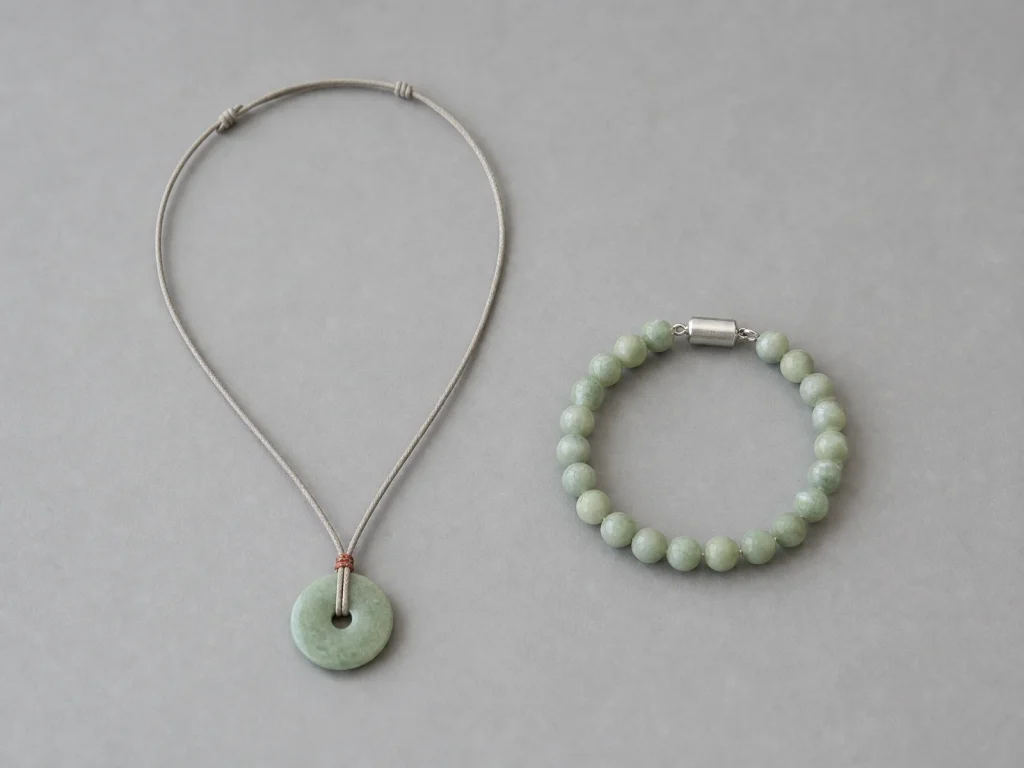
Measure your wrist
Wrap a flexible measuring tape around the place where you intend to wear the bracelet. Keep it flat and comfortably against the skin without pulling tight. Read where the tape meets its starting point and repeat the measurement. A narrow strip of non-stretch paper can also be marked at the overlap, laid flat, and measured with a ruler.
Record the wrist measurement and the wearing position separately from your preferred looseness. Measure the wrist you will actually use. Do not use an elastic cord as a measuring tape, and do not add a fixed allowance before checking how the particular bracelet is sized.
Read bracelet dimensions correctly
A bracelet's total length when laid flat, its usable closed length, and its inside circumference are different measurements. Large beads or thick links occupy space inside the loop, so two bracelets with the same stated overall length can fit differently. Confirm whether the clasp is included and whether the listed size describes the item or a recommended wrist range.
For an adjustable bracelet, check the usable adjustment range and where the remaining cord or chain sits. For elastic bracelets, fit should come from the intended size, not from keeping the elastic stretched against the wrist. Compare with a bracelet of similar construction that already fits comfortably; there is no single allowance that works for every design.
Closed bangles must pass over the hand
A closed bangle has to pass over the widest part of the hand before reaching the wrist. Wrist circumference alone cannot determine its size. If you already own a comfortably fitting round bangle, measure the clear inside diameter across its center, without including the material thickness. For an oval bangle, record both inside axes and its width.
To record hand size, gently bring the fingers together and draw the thumb toward the palm as you would when putting on a bangle, then measure around the widest part with a flexible tape. Hand shape, flexibility, and the bangle's profile affect the result, so this measurement does not guarantee a matching diameter. Use the item's specific guidance or an in-person fitting; never force a tight bangle over the hand.
Check where a necklace will sit
Use a necklace that sits where you like, open its clasp, lay it straight without stretching, and measure from end to end. Note whether that measurement includes the clasp and whether an extender adds length. A pendant's drop is normally a separate dimension, so confirm the seller's measurement convention.
You can also drape a flexible tape along the intended necklace path to compare lengths. Check the result with your usual neckline and allow for the pendant, rather than relying on a model photograph. Neck and shoulder shape, clothing, and pendant weight change where a necklace falls. Keep the tape loose and remove it after measuring.
Units, width, and weight
Use the same unit for your measurement and the item description. 1 inch = 25.4 mm exactly; 1 cm = 10 mm. To convert inches to millimeters, multiply by 25.4. Keep the original measurement when comparing and round only at the end; a size name or number without a unit and measurement type is not enough.
Check bead diameter, bracelet or bangle width, pendant height and width, and total weight as well as length. A broad or heavy piece can feel different from a narrow, light one with the same nominal size. Product photographs and cultural illustrations do not provide a reliable scale unless an actual measurement is given.
Make a final fit check
Match the exact item or variant to your recorded measurements, adjustment range, and preferred fit. Check that fastenings are manageable, the item does not catch on clothing, and normal movement is comfortable. If it pinches, leaves persistent pressure marks, or is difficult to remove, stop wearing it and reassess the fit.
For a gift, a similar item that the recipient already wears is a better reference than a guessed wrist or neck size. Confirm any size-adjustment or exchange terms before purchasing. The current catalog is a preview, and its images do not establish the dimensions or fit of a future item.